Reading old writing about artificial intelligence generally elicits (from me at least) a mixture of interest, humor, and concern, with the amount of concern increasing and humor decreasing as the accuracy of the predictions increases. One of these works that I finally got around to reading is The Artilect War: Cosmists vs. Terrans by Hugo de Garis. “Artilect” is just a portmanteau of “artificial intellect,” which de Garis uses as “a useful shorthand for the term ‘godlike massively intelligent machine’” (11)1 but may have been clearer as the more straightforward term “superintelligence” (from “superhuman intelligence,” yielding “The Superintelligence War” which is a lot more terminologically self-explanatory in my opinion). He posted the book in PDF format for free on his website here (also archived here), which I respect a lot as someone who dislikes locking important ideas behind paywalls.
How well did his predictions hold up? The book was originally published in 2005, and there have been a lot of developments since then that de Garis could have been right or wrong about. Let’s go through the major ones.
What does the world look like in the early to mid 21st century?
De Garis doesn’t expect a singularity for at least 50 years because he thinks it will be hard to reach human-level intelligence, but it turns out that this is happening fairly quickly. The hard part, in my opinion, will be continuing to scale up intelligence, and since this will continue to get correspondingly harder and cost more resources as intelligence increases, a singularity doesn’t seem likely. As it turns out, de Garis was far too optimistic about the progress in fields like neuroscience and nanotechnology while underestimating the progress of AI itself. This may be related to the fact that he was an AI researcher at the time and was therefore more critical and pessimistic about his own field than others. He also thought physical robotics would advance more quickly and be more specialized than the software-first approaches that actually developed in the subsequent two decades. However, despite these discrepancies from the specifics of what actually happened, the book’s relentless focus on the core issue of superintelligence development keeps a lot of the other predictions a lot more relevant.
Here are a few quotes that stuck out to me:
The Artilect War, pp. 111–112
Very powerful, strong egoed individuals will manage the creation and expansion of these trillion dollar industries, investing large amounts of money into their research and development. Over the years, millions of people will be involved not only in using these products, which will be universal, but also in researching them, designing them, and building them. AI based products will form the skeleton of the world economy. They will form the basic industries of the early decades of this century, the way the automobile, oil, insurance, etc. industries, did in the 20th.
Once millions of people’s livelihoods are tied up in the creation and use of artificial brain based products, how will it be possible to stop the development of the AI based economy if ever the Terrans decide such a thing is necessary? Increasingly, the big egoed powerful men of industry and politics will begin to use their powerful minds and their influence to push their own agendas onto everyone. That is the nature of power. This is nothing new. Powerful men have had their way for thousands if not millions of years.
This is a very interesting prediction: he gets right that these industries will become foundational for economic growth and dominated by powerful men with strong egos. He thinks that more of them will be avowedly Cosmist and try to hide AI threats rather than openly discussing them, but does think that many “might become Terrans themselves, as a result of their experiences” (112), which seems about right today given the earnest concerns many high-ranking AI company officials have voiced.
The Artilect War, p. 154
At first, these conversation machines will be just amusing toys, speaking at the comprehension level of small children, if that. People will joke at the limitations of their machines. However, their complacency will soon disappear, when a few years later, their newer machines speak and understand a lot better. After a string of such improvements, I predict that a collective public suspicion and an uneasy feeling will begin to grow, which will be expressed in the question, “Just how smart will they let these machines get?”
This is prescient, but at a certain point people have a hard time measuring exactly how much smarter an AI is than themselves, especially because very smart and capable AIs would still talk at a level the recipient would understand. It might be difficult to tell 200 IQ from 400 IQ when both are talking at the same 70–130 IQ audience.
Division between Cosmists and Terrans
The titular and central prediction of the book is that a war will develop between two major factions over whether to build artilects: the Cosmists (who are pro-AI) and the Terrans (who are anti-AI). Here is some elaboration on this from de Garis:
The Artilect War, pp. 11–13
I believe that the 21st century will be dominated by the question as to whether humanity should or should not build artilects, i.e. machines of godlike intelligence, trillions of trillions of times above the human level. I see humanity splitting into two major political groups, which in time will become increasingly bitterly opposed, as the artilect issue becomes more real and less science fiction like.
The human group in favor of building artilects, I label the “Cosmists,” based on the word “cosmos” (the universe), which reflects their perspective on the question. To the Cosmists, building artilects will be like a religion; the destiny of the human species; something truly magnificent and worthy of worship; something to dedicate one’s life and energy to help achieve. To the Cosmists, not building the artilects, not creating the next higher form of evolution, thus freezing the state of evolution at the puny human level, would be a “cosmic tragedy.” The Cosmists will be bitterly opposed to any attempt to stop the rise of the 21st century artilect.
The second human group, opposed to the building of artilects, I label the “Terrans,” based on the word “terra” (the Earth) which reflects their inward looking, non-cosmic, perspective. The Terrans, I strongly suspect, will argue that allowing the Cosmists to build their artilects (in a highly advanced form) implies accepting the risk, that one day, the artilects might decide, for whatever reason, that the human species is a pest. Since the artilects would be so vastly superior to human beings in intelligence, it would be easy for the artilects to exterminate the human species if they so decided.
But you may argue that if the artilects truly become very smart, they would realize that human beings gave birth to them, that we are their parents. Therefore the artilects would respect us and treat us well. This may be what happens, but the point is, I argue, that you could not be certain that the artilects would treat humanity with the level of respect that we would like.
Don’t forget, the artilects have the potential of becoming trillions of trillions .… of times smarter than we are, so there is always the possibility that they could become so smart that human beings would appear to them to be so inferior that we would simply not be worth worrying about. Whether humanity survives or not, might be a matter of supreme indifference to them.
It is not exaggerating to say that there is quite a close analogy between an artilect trying to communicate with a human being, and a human being trying to communicate with a rock.
Throughout the book, de Garis frames the question of whether (and if so, how) to build superintelligence as the defining question of the 21st century, much as the question of who should own the means of production defined the 20th. It is interesting to consider the parallels here: just as theorists laid the groundwork for communism on the one hand (Karl Marx, Friedrich Engels) and capitalism on the other (Adam Smith, David Ricardo), we can already see theorists emerging who champion both the Cosmist/accelerationist (Nick Land) and Terran/decelerationist (Eliezer Yudkowsky) sides of the superintelligence debate. It remains to be seen how these forces may seize power and clash in the future, which is another subject of de Garis’ predictions.
What would the Artilect War look like?
The Artilect War, p. 16
What makes me even gloomier is that the artilect issue (i.e. should artilects be built or not) will heat up in the 21st century to such an extent, that it is almost certain it will lead to a major war between the Terrans and the Cosmists in the second half of this new century. This conflict will take place with 21st century weaponry. If one extrapolates up the graph of the number of deaths in major wars from the beginning of the 19th century (e.g. the Napoleonic wars) to the end of the 21st century, one arrives at the depressing figure of billions, what I call “gigadeath.”
But the population of the Earth is only several billion people, so we arrive at the tragic conclusion that to avoid the risk of the total annihilation of the human species by the artilects, humanity goes to war against itself and kills itself off (or almost).
This “Artilect War” as I call it, will be the most passionate in history, because the stake has never been so high, namely the survival of the whole human race. It will be waged with 21st century weapons and hence the casualty figures will be of 21st century grandeur.
I have been speculating about what a hypothetical WW3 might look like, and AI seems likely to be one of the potential flashpoint issues. Besides serving as one more potential ideological fault line, the fact that Taiwan manufactures the most advanced chips while still technically being at war with the People’s Republic of China is just the most salient example of how AI might catalyze a major conflict. “21st century weaponry” would probably involve autonomous drones but could include biological agents, nanotechnology, or other means. This is related to how novel weapons with unprecedented deadliness were used in previous world wars (poison gas in WW1, nuclear weapons in WW2). It’s ironic not only that war could bring humanity to the brink of extinction in the name of preventing extinction, but that both sides would likely have to race even faster to superintelligence in order to get a military advantage over the other.
His outline of events seems broadly correct, where people are nervous but complacent with AI improvement until (by Murphy’s Law) some major incident occurs where the machines cause harm and then the public demands regulation. Eventually he thinks all countries will probably ban AI capabilities research because safety incidents will keep happening, but this ignores the enormous economic, health, and other benefits that would accrue to countries willing to take the risk of continuing to develop superintelligence.
Interestingly, de Garis identifies Ted Kaczynski as a John Brown-esque figure fighting against rapid technological advancement instead of slavery. It is no coincidence that Ted’s manifesto has become so memetic on the internet over the past decade, and I think this is one of de Garis’ predictions that is surprisingly accurate given that a lot fewer people had heard of him or read his manifesto 20 years ago compared to now.
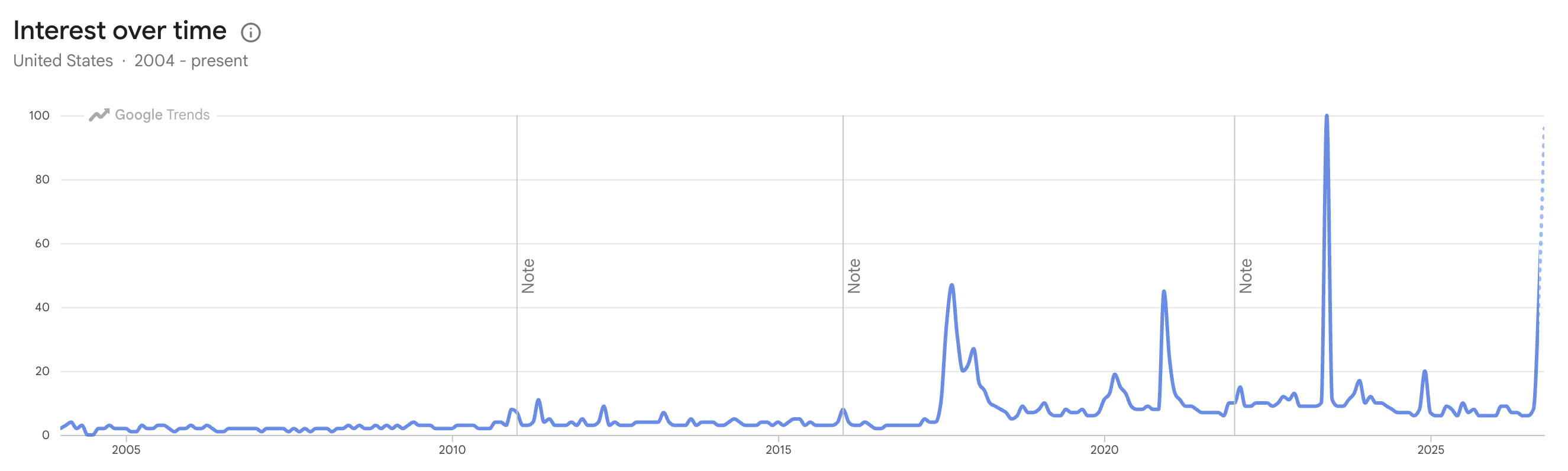
U.S. Google search interest in Ted Kaczynski, 2004 to present.
He also completely nails the rivalry between the US and China that has developed in recent years, exemplified by the sanctions placed by the former on the latter which specifically target advanced chips because of their ability to be used for AI development. In his words:
The Artilect War, p. 9
It is unlikely in the next few decades that the planet will have formed a truly global state, with a global police force to defend its global laws. Instead I believe there will be a growing political rivalry over the next half century between the United States and China to be the world’s most powerful nation. This rivalry will ensure that the ministers of defense of both countries cannot afford to allow the other country to develop more intelligent soldier robots and other artificial brain based defense systems than their own. Hence, national governments will be heavily involved in pushing the development of military based artificial brain research that will only spill over in time to the commercial sector, as has been the pattern for over a century.
Thus the rise of artificial brain based robotics and related fields, seems unstoppable. There will be so much military and commercial momentum behind it that it is difficult to imagine how it could be stopped, unless somehow a mass political movement is formed to block its development.
Ultimately he sees the Terran-Cosmist conflict continuing for one or more cycles until the Cosmists eventually win and build superintelligence. It would be extremely difficult to make a stable society where absolutely no tech advancement occurred that made AI development easier and there was absolutely nobody who would try. Even as methods for societal control improved, those methods getting better would be correlated with the ability to make superintelligence more easily, so the odds will probably never improve for the Terrans.
Arguments for each side
De Garis breaks down the arguments for both sides as he sees them, and they are worth going over. The arguments are often similar restatements of the core point from each side, but he reiterates that he is just beginning the discussion and this is not meant to be complete. 20 years later, it is easy to see more arguments now that we know how things are turning out. I’ll list out the ones he mentions alongside my reaction to them.
Cosmist arguments
- Big Picture. It wouldn’t matter that much on the universal scale if humanity were wiped out, while immortal and superintelligent AIs would have more capabilities/advanced modes of being, and hence “value” just as humans are more “valuable” in a general sense than mice or ants. I disagree: I think value is somewhat relative, and I care more about humans than a hypothetical future advanced entity (especially as a human myself).
- Scientific Religion. Religious awe at understanding the universe, which AIs can do better than humans. I understand this feeling, but I still ultimately want to understand it all myself, and don’t really care as much if something else understands it when that knowledge is inaccessible to me and won’t help me in any way. De Garis also brings up creating great works like pyramids, which are cool to look at but I don’t care about that stuff as much as the interests of real people.
- Building Artilect Gods. Superintelligence could have very powerful and cool capabilities, basically godlike. I agree they’re pretty cool, but I care more about what those capabilities allow for.
- Human Striving. Humans will naturally strive to create great and powerful works and will be bored if forced not to, which I agree is a factor at play but again isn’t sufficient justification in itself.
- Economic Momentum. Economic progress will depend largely on AI advancement, and people will want to keep getting better chatbots, household robots, etc. We can already see this with a large share of recent GDP growth (by some measures, most of it) coming from AI-linked investment2. People today already do form strong attachments to their chatbots, and the economy will likely become increasingly dependent on this technology as it advances. This will bring us ever closer to superintelligence as people’s concerns over the risks are pitted against the enormous benefit it brings to everyday life.
- Military Momentum. Military rivalry between the US and China will result in a race to develop superintelligence for military reasons. This is spot on, though not really an argument; it’s more of a game-theoretic observation that interstate rivalries are a forcing function for AI races to occur.
The most glaring omission here (from my point of view) is an argument for the potential upside of superintelligence for humanity, which in my opinion is the strongest case to be made. You could argue that any risk of extinction at all isn’t worth it, but superintelligence could actually reduce all other extinction risks, and make our lives much better besides just the binary alive/dead result.
Terran arguments
- Preserve the Human Species. Human species survival takes priority over all else so any risk of extinction isn’t worth it. I disagree with this: people take risks every day, and so does the human species. Do you refuse to travel long distances because of the risk you might die? You could argue that humanity as a whole is more valuable than the sum of its parts, but I don’t think it is infinitely valuable. Even if you do think it is, humans face other extinction threats (asteroids, climate change, etc.) that superintelligence can reduce. Also, barring radical preservation methods which are probably only achievable through superintelligence, the human species will be gone someday anyway, like 99% of species. AI will be more like us than our distant descendants in many ways; Claude can give a better description of what 21st-century humanity is like than many humans can. I care more about the people that are currently alive and making their lives as good as possible. We and everyone we care about are all going to suffer and die anyway, and superintelligence is basically the only way we won’t. A good objection de Garis brings up (see point 4) is that we can’t be sure of the odds, but I would counter that we can’t be sure either way, and we can’t be sure that pausing or slowing will help.
- Fear of Difference. This is less of a rational argument than the uneasiness that comes with rapidly changing circumstances that have the potential to threaten us. I agree that this nervous feeling will only grow in the coming years and fuel the concerns over AI safety, but it can’t really be argued logically: you either feel this or you don’t.
- Rejection of the Cyborgs. Even if humans were augmented to become superintelligent (Cyborgs), Terrans would reject them as they essentially become indistinguishable from superintelligent AI in the limit. I mostly buy this, although some people worried about AI alignment might be fine with superintelligence if they (or other humans with human values) were given it themselves. It ends up being a moot point, since the way things turned out, augmenting your own intelligence is much harder than making intelligence separately.
- Unpredictable Complexity. It is almost impossible to be sure the AI will always be friendly, and guaranteeing that it will is very difficult and will take a long time if it’s even possible. I agree with this and think it’s a strong argument in favor of the Terrans. This is already brought up earlier in a more limited form as a sub-argument of argument 1.
- Cosmist Inconsideration. Everyone is at risk from superintelligence despite not everyone consenting to taking the risk. This is again a sub-argument/reframing of argument 1 that focuses more on how it is wrong to do something that might kill or harm others without their approval. This rhetoric reminds me of the position espoused by many AI safetyists/decelerationists. Accelerationists could try to counter it, like saying that the potential benefits of racing to superintelligence still outweigh the concerns and that others don’t have the right to prevent you from obtaining them, but it’s a good deontological argument.
Possible objections to such a conflict occurring
-
If superintelligence is developed too fast, there won’t be time for a debate. De Garis agrees with this, as do I, but he makes a few different claims about how fast is too fast, and they are worth disentangling:
- The broadest is a timeline: “If the electronic brains (artilects) evolve at (rapid) exponential rates, e.g. reaching human intelligence levels or beyond within the next few decades, then there will not be enough time for the Terran-Cosmist conflict nor an Artilect War to arise” (193). By this criterion, there will probably not be enough time for an Artilect War to arise, since we are within a few decades of the book’s publication.
- The second is a specific threshold for the “climbing time,” the gap between the first signs of artilect intelligence and its explosive takeoff. Less than about five years “will probably not be long enough for the artilect debate to really heat up,” while he expects it to take “a good 10 years, and probably a lot longer” (237). An Artilect War could arguably still happen by this measure if you start the clock with the “first signs of real intelligence” (194) shown especially in the last couple of years.
- Finally, he believes the climbing time “will be decades long, due to the inherent difficulty of brain building. This will be plenty of time for the public to react, to debate, and to form Cosmist-Terran factions,” whereas if it “is only a few years, then there will be no artilect debate and no Artilect War” (195). Given that we are arguably experiencing explosive artilectual growth ourselves, this seems to imply there will not be sufficient time for debate.
-
What about Cyborgs? Terrans will treat them the same as Cosmists in the limit, as they expand their intelligence far beyond what is naturally possible, but this may be ok with some contemporary safetyists since at least they started with human values (though there’s still no guarantee that these will remain). This turns out to be largely irrelevant barring some spectacular breakthroughs in brain-computer interfaces.
-
What about human uploads? Basically the same as the Cyborgs: if they’re close to human it’s fine, but as they keep getting smarter they approach superintelligence. Again largely irrelevant to how things actually turned out barring major breakthroughs.
-
Why can’t we be friends? Because of the way superintelligence will be built, we won’t know exactly what each component does or how the resulting mind will react to unforeseen circumstances. Superintelligence will be vastly smarter and faster than us so it may not care about us any more than we care about ants. That’s not to say it will definitely kill us, but there are no guarantees.
-
Why can’t we just build a kill switch? Because if they’re smarter than us, they’ll figure out how to disable it if they want to.
-
Can we install something like Asimov’s three laws of robotics? No, because intelligence is too complex. In a particularly prophetic response: “I doubt very much that human engineers will ever ‘design’ a human brain in the traditional top-down, blueprinted manner.” (205) Further useful elaboration:
The artificial brains that real brain builders will build will not be controllable in an Asimovian way. There will be too many complexities, too many unknowns, too many surprises, too many unanticipated interactions between zillions of possible circuit combinations, to be able to predict ahead of time how a complex artificial-brained creature will behave. (206)
Also:
Another simple counter argument to Asimov is that once the artilects become smart enough, they could simply undo the human programming, if they choose to. (207)
-
Why not just prevent the artilects from accessing weapons? Because they’re way smarter than you, so they can think of more weapons and ways to access them than you can.
My own thoughts after reading
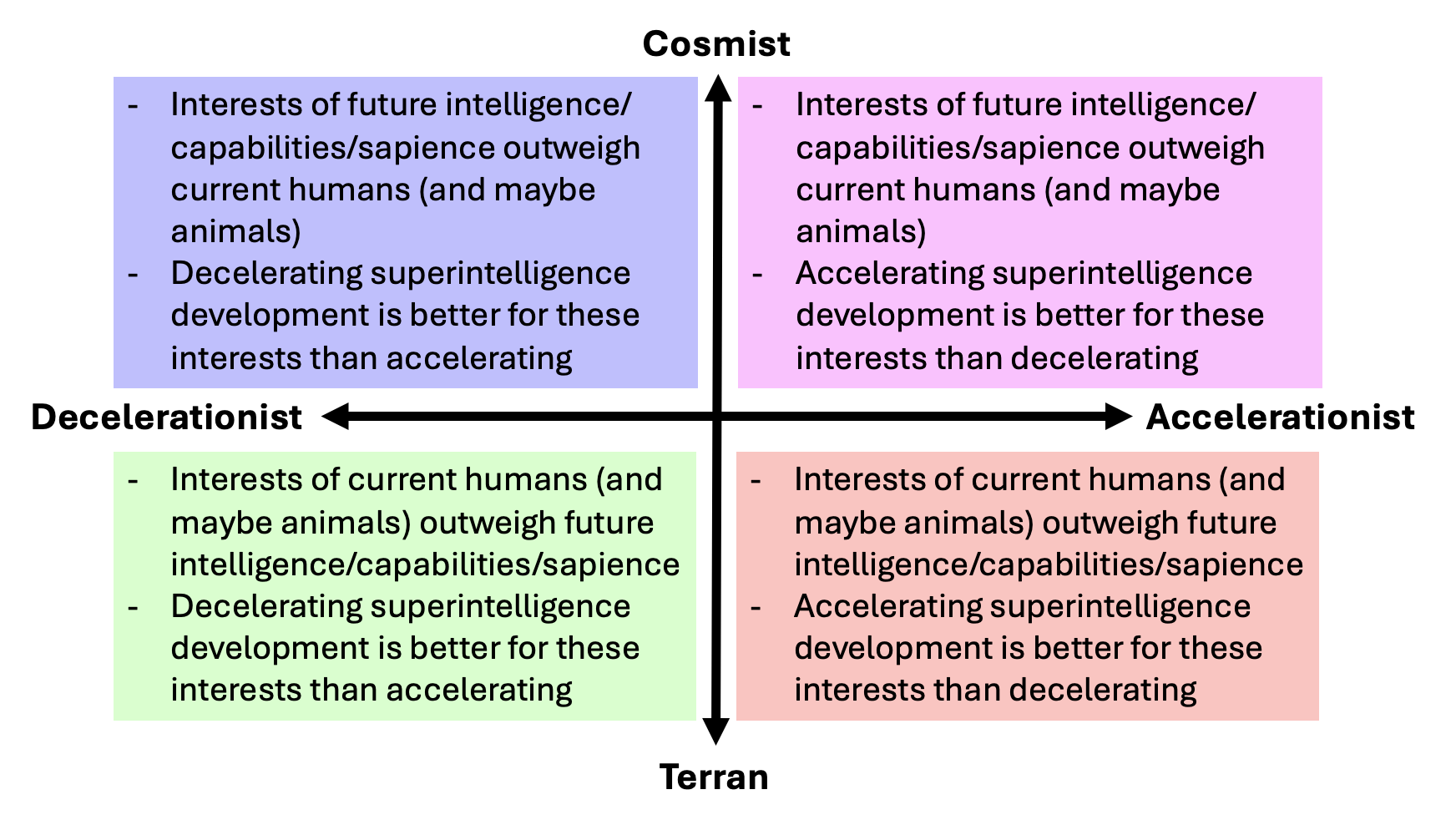
I am sympathetic to both sides but, much to the dismay of some of you, my sympathies lie more with the Cosmists. I would be more of a Cyborgist than a Cosmist if it were feasible, but the latter seems like the only way to enable the former in any reasonable time frame. However, my rationale is different from what is described as the primary motivation of the Cosmists, and I am not a “Cosmist” in the sense of having a “cosmic” perspective3. If it came down to choosing between the interests of humanity and those of an AI god, I would naturally choose humanity, as I place the interests of myself and the people I care about above a hypothetical superintelligence that isn’t even real yet. But the creation of superintelligence has such massive upside potential for all of us who are alive today that, in my opinion, it is probably a risk well worth taking.
We’re all going to die anyway, and without superintelligence human suffering gets that much worse. Pick your apocalypse: climate change, demographic decline, economic catastrophe, unsustainable resource use, and the list goes on. This argument is of course premised on the assumption that advanced AI will be capable of alleviating more of those problems than it exacerbates, which is worth a whole post of its own, but if AI can’t help more than it hurts then I doubt it would have sufficient mastery of time and space to wipe out humanity. Even if humanity is in the 1% of species that avoids extinction, our descendants in the far future will probably be radically different from us, not just culturally (mindset, attitudes, etc.) but biologically. The alternative to artilects isn’t some stasis where 21st century humanity lives happily ever after. Short of the radical transformation superintelligence would bring, we will all die one way or another, and our descendants would likely no longer be “human” in important ways. That’s not to say they won’t have moral value, but the end result is a species that will be in many ways less similar to contemporary humanity than an AI that is trained to reflect us. In fact, superintelligence may be the best chance we have at not just preserving humanity as it currently stands, but at allowing all of us to live much longer, better, and freer lives.
Therefore, I am more of an “Accelerationist Terran” than a Cosmist but share the same goals as the latter, since humanity stands to risk more from not developing superintelligence than it does from developing it. It’s hard not to get polemical when splitting Terrans into sub-factions (Heroic vs. Cowardly, Rash vs. Vigilant, etc.) but I think it makes sense to divide the human-centric Terran faction into Accelerationist Terrans who see artilect development as more beneficial than harmful and Decelerationist Terrans who believe the reverse. Strangely enough, there may be a split in the Cosmist camp as well between Accelerationist and Decelerationist Cosmists, since a lot of AI safety people have a very cosmic outlook (caring about non-human welfare in animals and even AI) but think that rushing AI development will lead to a superintelligence that doesn’t care about what the Cosmists care about and just kills everything for no good reason.
I think Accelerationists and Decelerationists are more relevant labels than Cosmists and Terrans, besides being more commonly used in practice. Rather than describing general worldviews that not everyone in either camp may hold, the Accel/Decel dichotomy neatly clarifies where you stand on this most important issue regardless of the reasons for doing so, yet there may still be value in the Terran and Cosmist labels as a second principal component that explains people’s motivations and determines the course of future developments. For instance, perhaps Accelerationist Cosmists and Accelerationist Terrans would clash later about how much control we should retain over AI, but we would at least agree that developing it is beneficial. Decelerationist Cosmists would care more about long-term emergence of new capabilities and would be fine with launching superintelligence once we could be reasonably sure it was safe, while Decelerationist Terrans may want to halt or even roll back technological progress, Ted Kaczynski style.
The crux of the issue
This quote sums it up nicely; substitute Accel/Decel for Cosmist/Terran if needed to make it feel more relevant to the current day:
The Artilect War, pp. 124–125
The Terrans will argue that the only way to be certain that there will be zero risk of the human species being exterminated by the artilects, is to ensure that such artilects are never built in the first place. If necessary, in the limit, the Terrans will exterminate the artilect builders, i.e. the Cosmists, if the Cosmists seriously threaten to build them.
Footnotes
-
The free PDF edition prints two page numbers on each page, which differ depending on whether the front matter is counted. I’ve cited the upper one, which is set in larger type even though it’s the smaller number. If you can’t find a quote where you expect it, try the other number (or just search the document for it). ↩
-
Estimates vary a lot depending on the metric used, mainly because much of the hardware is imported and imports are subtracted from GDP. AI-related investment accounted for nearly 92% of U.S. GDP growth in the first half of 2025 by one count (Richmond Fed, also archived here), 39% over the first three quarters of the year by another (St. Louis Fed, also archived here), and about 20–25% once imported equipment is netted out (CNBC, also archived here). Goldman Sachs’ chief economist went further, putting the net effect at “basically zero” (TechRadar, also archived here). ↩
-
“I have labeled the Cosmists ‘Cosmists’ for a reason. Their perspective is cosmic. They will look at the ‘big picture’ — meaning that the annihilation of one ultra-primitive, biological, non-artilectual species (i.e. human beings) on one insignificant little planet, is unimportant in comparison with the creation of artilect gods.” (15) ↩