I just started reading John Milton’s Paradise Lost for the first time, and it’s quite good. What stands out the most to me is his epic poem’s strictly metered non-rhyming structure, which I find interesting but not especially compelling relative to the content itself. He justifies his choice thus:
“The measure is English heroic verse without rhyme, as that of Homer in Greek, and of Vergil in Latin; rhyme being no necessary adjunct or true ornament of poem or good verse, in longer works especially, but the invention of a barbarous age, to set off wretched matter and lame meter; graced indeed since by the use of some famous modern poets, carried away by custom, but much to their own vexation, hindrance, and constraint to express many things otherwise, and for the most part worse than else they would have expressed them. Not without cause therefore some both Italian and Spanish poets of prime note have rejected rhyme both in longer and shorter works, as have also long since our best English tragedies, as a thing of itself, to all judicious ears, trivial and of no true musical delight; which consists only in apt numbers, fit quantity of syllables, and the sense variously drawn out from one verse into another, not in the jingling sound of like endings, a fault avoided by the learned ancients both in poetry and all good oratory.
This neglect then of rhyme so little is to be taken for a defect, though it may seem so perhaps to vulgar readers, that it rather is to be esteemed an example set, the first in English, of ancient liberty recovered to heroic poem from the troublesome and modern bondage of rhyming.”
— John Milton
The TL;DR is that he doesn’t like rhymes, but uses largely unrhymed strict iambic pentameter in a throwback to ancient Roman and Greek poetry1. I like how he frames his argument as this seemingly new poetic form actually being traditional “heroic verse” in contrast to the contemporary fashion of rhyming. His dismissal of rhymed endings as having a “jingling” sound made me chuckle.
This made me think about whether you need either structure or rhyme to make good poetry. To me, one aspect of good poetry is that it is memorable, and both structure and rhyming seemingly help with this. For instance, think of the classic “Roses are red, Violets are blue” with any number of possible endings. Not only are both lines four syllables with emphasis on the first and fourth of these, but “blue” is always supposed to rhyme with whatever the end of the following lines are (for instance, “…Sugar is sweet, And so are you.”). This explains why modern songs, especially catchy ones, have both of these elements. Rap in particular is interesting as a (relatively) spoken-word medium that deploys rhyming and verse structure to great effect.
It is interesting then that modern poetry mostly eschews both of these elements. At first I didn’t really appreciate completely unstructured verse, having come across a few contemporary poems that made me roll my eyes and move on. But then there is this example, which resonated unusually strongly:
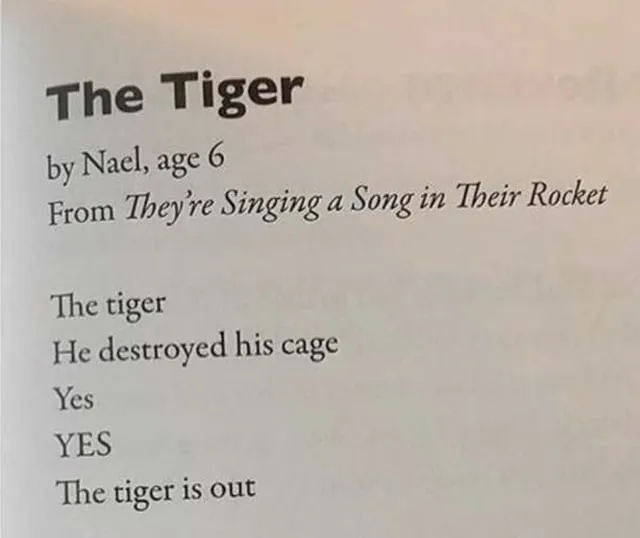
Despite not thinking about it that often, I can still recite this poem by heart2. It does a great job taking an instantly captivating situation that could be concerning, violent, or tragic and instead uses it to emphasize the eminently relatable feeling of sudden freedom from a cage. It’s probably the most popular poem on the internet, likely due to a combination of its quality and its brevity.
Therefore, it would seem that in order to make free verse memorable, it should be both powerful enough and short enough to overcome its lack of any familiar structure. Additionally, this is just conjecture, but it seems harder to make free verse poetry that has wide appeal than to do the same with structured and rhyming poetry. This could be related to its memorability as well as the fact that there are so many more degrees of freedom for people to find fault with. Maybe this is similar to why modernist architecture is generally disliked; fewer rules means it is harder to please everyone. That doesn’t mean that free verse is necessarily less good than structured poetry, just that fewer people view individual examples of the former as positively as they do the latter.