One of my friends recently downloaded a dating app to try and meet more women. This is broadly commendable, as he is making an effort to pursue his goals rather than not taking any action while complaining about lack of success, even if that effort is largely comprised of taking pictures, coming up with witty quips, and swiping madly. I wish him the best of luck, but hearing about his experiences made me think about the effects of apps being the primary means of human romantic and sexual connection.
If you look at graphs of how couples meet each other over time, it looks something like this:
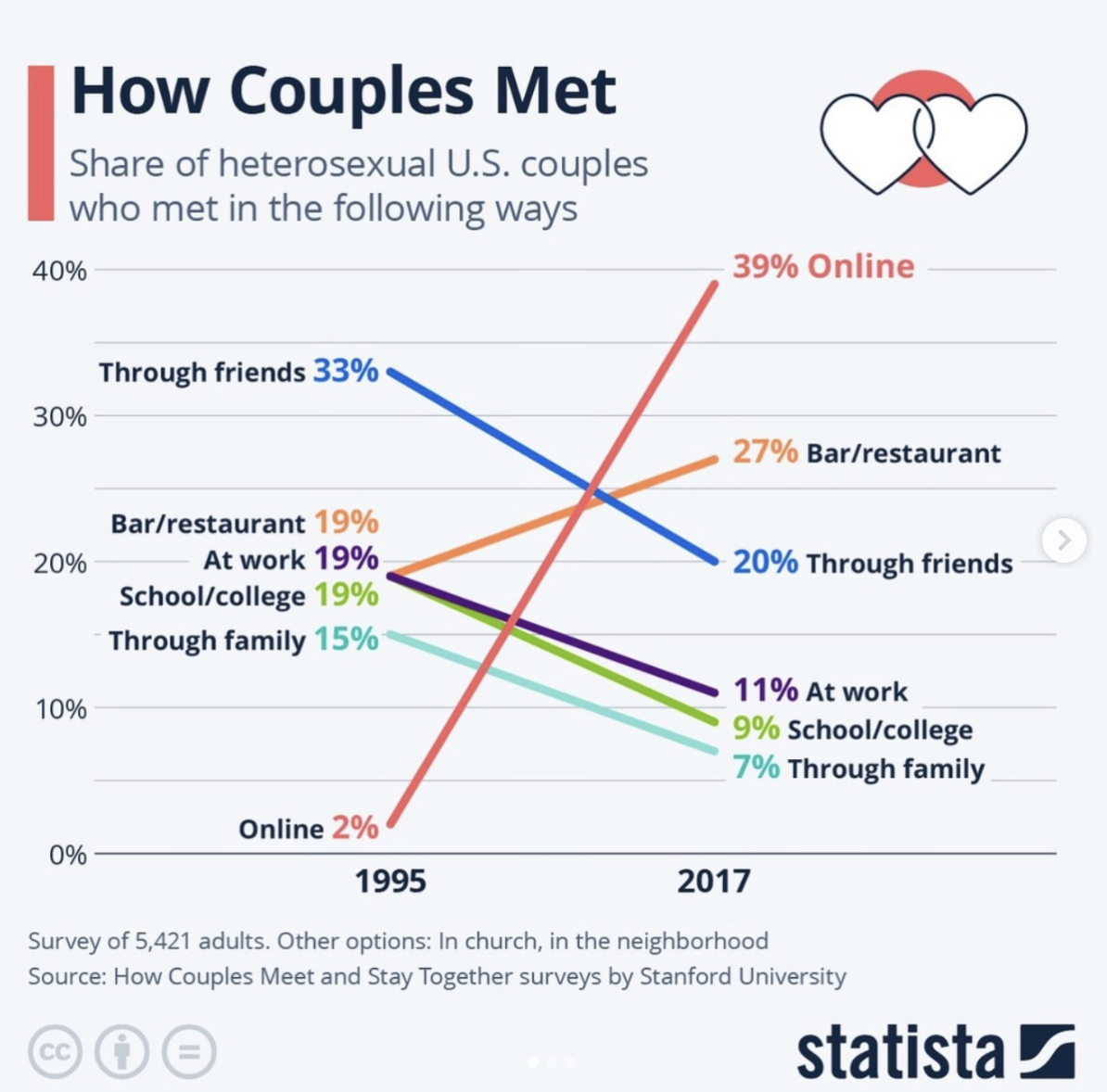
More recent data1 shows that 60% of couples met online in 2024. Furthermore, online dating has moved from being more text-based to image-based, as “date me” posts gave way to apps that show users an image of the prospective match with only a few basic details about biography, preferences, and interests.
In one sense it’s not all that different from seeing someone cute across the bar, chatting it up about some initial topics, and then getting a number for further messaging and date scheduling. Looks and other superficial details have always played a role in romantic success, and catfishing2 experiments only confirm what many have known for a long time. Online dating may exacerbate the effects of looks since there are way more potential matches than just whoever is in physical proximity, and given the abundance of options attractiveness becomes an easy way to filter people. Once the connection is mutually initialized, what follows resembles the initial texts after getting someone’s number, albeit with less context other than the initial profile. This, combined with the lack of mutual social connections or context, makes ghosting much easier than it is from many IRL settings.
The biggest difference to me is how the forces governing who interacts with whom have changed. Instead of an initial chat after quasi-random encounters where one person works up the courage to talk to the other, various opaque algorithms are at work. Furthermore, these algorithms are in the service of companies that are motivated by profit, and which may incidentally have incentives aligned with yours (finding a romantic or sexual partner) but often have the opposite motive (getting you to stay on the apps as a paying customer for as long as possible). Hinge’s slogan is “designed to be deleted,” which seems to indicate the right priorities, but without an open-source algorithm we don’t really know whether they live up to it. The picture gets more suspicious when you notice that Match Group owns Hinge, Tinder, OkCupid, and Match itself, so “competition” between the major apps is largely internal to one corporate parent.
Without inside information that these companies will likely never reveal, it is difficult to figure out exactly how these forces operate, and therefore to understand both how this is affecting people as well as how to improve things. One could imagine governments stepping in to provide dating apps as a public service to give their citizens one more way to find love (and potentially produce more taxpayers). But even then, government incentives may also be misaligned with those of the users themselves. Short of getting to see the code ourselves, the entire landscape of our sexual and romantic relationships remains significantly altered based on the will of a few massive, inscrutable corporations. We should reflect on whether this should remain the case going forward. A government-run platform might be a bad idea, and breaking up the oligopoly may just make things harder as people scatter to niche platforms, but since individuals can’t really change things and move to platforms by themselves there is a role for external actors to change things for the better, such as companies acting in their users’ interests more verifiably, or government regulation to do things like open-source matching algorithms, help users better understand how the apps work, or otherwise act to protect their citizens’ interests.
Footnotes
-
James Eagle’s animated chart of how couples met from 1930 to 2024, posted to LinkedIn (also archived here). ↩
-
and its more niche cousin, chadfishing. ↩